Research Notes: “‘Camp Nature’ Nerepis, N.B.” (poem on birch bark, 1900)

Loyalist City Coin in uptown Saint John is a great place to find regional materials long out of print, and last week I spent over an hour flipping through their document bins, pulling out whatever I thought might be of interest to friends and family. For myself, I was delighted to find Joleen Gordon’s book on Edith Clayton’s market baskets, which I hoarded from the UNB library for most of the duration of my PhD, perennially hoping for the time and opportunity to write something about splintwood basketry as an important literary tradition in Nova Scotia.

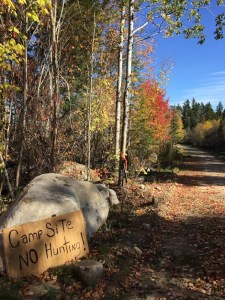
This poem, written on birch bark and dated August 7, 1900, also stood out to me.

1900 Aug. 7 “Camp Nature” Nerepis N.B.

We sit and look each other at
And feel that we could fly
Because we’re content and all that
Just having done blueberry pie

Mrs. McKenzie kind and good
Some luscious pies did make
And sent to “Camp Nature” in wood
One that just simply took the cake

As long as Mrs. Mack’s on earth
May she be blest with all that’s good
‘Tis wished of Pies there’ll ne’er be dearth
By those in “Camp Nature” in wood.

“Argole”

Provincial, county, university, and museum archives remain closed at this time, and so the amount of digging I’ve been able to do into the various contexts for this document remains limited. Perhaps unsurprisingly, my Google search for “McKenzie+Nerepis+Pie” was fruitless.

In an essay from The Creative City of Saint John, Donald McAlpine describes Camp Nature as a “summer retreat” on the Nerepis River that “was built between 1899 and 1902 by William McIntosh and Gordon Leavitt on property owned by McIntosh. The camp was the site of Natural History Society of New Brunswick outings, and both McIntosh and Leavitt pursued entomological activity in the surrounding area, Leavitt collecting species of sawflies new to science” (38). We know that Settlers in the nineteenth and twentieth centuries sometimes wrote on birch bark: in 1862, for example, Alex Monro prepared the table of contents for his Native Woods of New Brunswick: – 76 Specimens on bark; and in the 1940s, some soldiers wrote letters home on bark, generally making use of whatever materials were available to them.

Image source: Rodney Arthur Savidge Milham Lecture, March 22, 2000. Link

If it is likely, then, that the date of 1900 on the poem is accurate, and that it was written by someone either summering or visiting at Camp Nature in Nerepis, then other Nerepis (or Nalihpick/N’welihpick, meaning “the place where I eat well”) contexts may be relevant. Micah Pawling has written about seasonal camps throughout the Wolastoqey homeland, and he cites the camp at at the confluence of the Nerepis and Wolastoq rivers as one of many instances in which, after the establishment of reserve lands, Wolastoqi people maintained connections with the southern river valley.
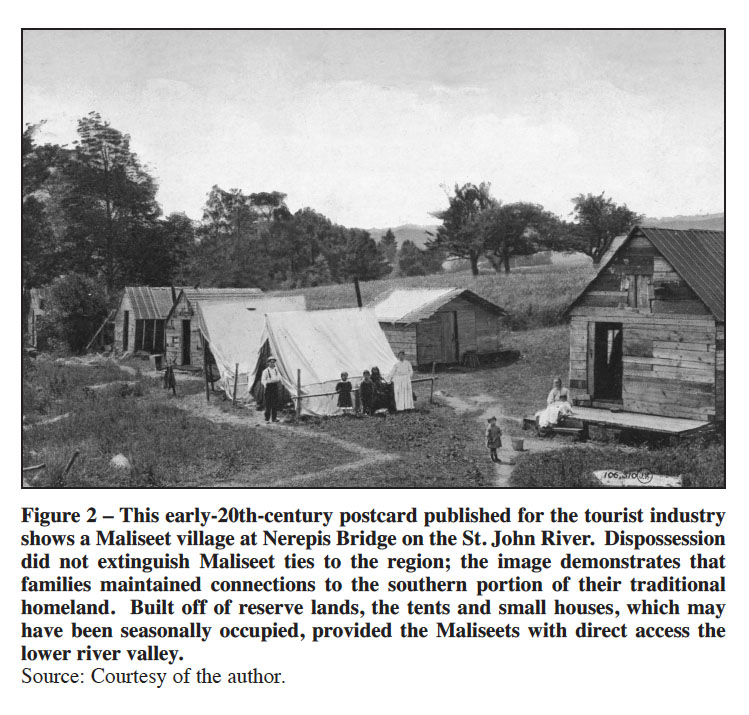
Image source: Micah Pawling, “Wəlastəkwey (Maliseet) Homeland:
Waterscapes and Continuity within the Lower St. John River Valley, 1784-1900
,” Acadiensis 46.2 (2017) Link

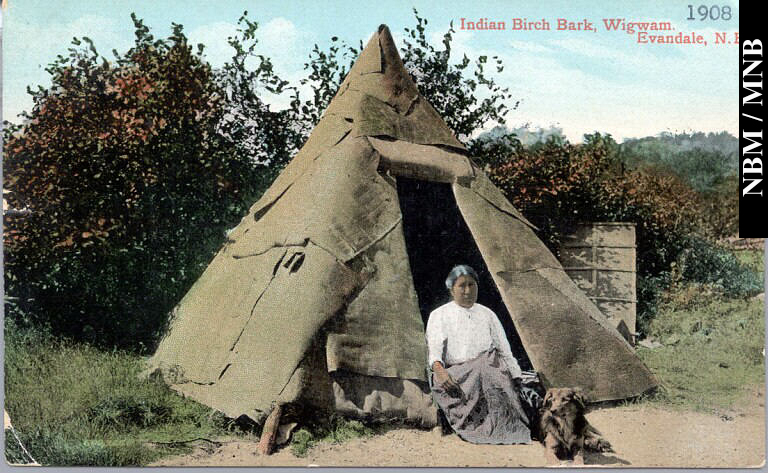
Anne Sacobie, who lived at St. Mary’s, is but one person who is said to have returned to the camp at Nerepis, along with other camps throughout the southern Wolastoqey homeland, for many years. The following image of her at Evandale is featured on an historical display midway across the Nerepis bridge, which I drove out to examine shortly after finding the poem:

Image source: Link

The Wolastoqey camp at Nerepis was active until the 1970’s. Its inhabitants would harvest fiddleheads, ash, and sweetgrass, trap muskrat, fish, and sell or trade materials with other local residents. I do not yet know to what degree the populations from Camp Nature and the Wolastoqey camp might have socialized, but it would not surprise me to learn that the inhabitants of the former benefited — in terms of both materials and information — from the proximity of the latter. At this point in my inquiry, all I can do is speculate, which is not especially useful.

When I first saw this poem in the bin, I immediately intellectually placed it in the tradition of awikhiganak, the writings on birch bark that predate European literary systems in this land. For the Wolastoqiyik, awikhigan had many uses, but one was to communicate survival information, including information about where to find food. I love this poem — about how to stave off blueberry pie scarcity — as an awikhigan, and I am pondering the degree to which this context remains intact and relevant whether it was penned by a Wolastoqi person or not.

Because there is a possibility, however small, that this poem was written by a Wolastoqi person, I am sharing this information early in the research process. It feels ethically ambiguous to keep it to myself, and certainly, if there is any chance that this is a piece of Wolastoqiyik material culture, then I would like to return it to a citizen of that nation as soon as possible. Please e-mail me at rbryant@dal.ca (or send me a message wherever we may be connected) if you have any thoughts or concerns about this aspect of the project.

If, as I currently suspect, the poem was written by a Settler, I am interested to pursue the questions of how Settler and Indigenous communities related to each other in Nerepis at the turn of the 20th century, and in what spirit Settlers in this region, including Monro and others, have participated in the tradition of awikhiganak.

Update: Shortly after publishing this note, I was grateful to hear from Peter Larocque at the New Brunswick Museum: “Just saw your research note regarding Camp Nature. I am not completely certain, but almost convinced that the author, Argole, is one of Camp Nature’s founders, Arthur Gordon Leavitt. ARGOLE is most likely an acronym using the first two letters of each of his names.”
Remembering Each Other

My children are young, and I am responsible for remembering their lives – from the elaborate baby books to the time my three-year old, now six, identified the contents of a ground beef package at the grocery store as meat noodles.

If I don’t record these moments, these milestones, they will dissipate like dandelion spores. There will never be another source for this information. Nobody will ever know these dandelions like I do. Google baby book guilt – it’s a whole thing, this feeling that their childhoods are slipping away unrecorded, this fear that I will, as a parent, be someday held to account over my handling of these details. When did I first wave? my third-born adult child will demand, sadness and accusation in his eyes. How big was my head?

There are apps that will text me specific questions about my children, recording the answers for posterity so that even if I forget, even when I’m too busy, the archiving process will continue. What is [Child A’s] favourite bedtime story? Does [Child B] collect anything? These companies will turn my answers into books and keepsakes if I pay them enough, but what I use instead are large, grey Rubbermaid totes, stacked in a tower in the basement and filled with the material fragments of my children’s lives, from NICU wires and hospital bracelets to locks of hair, post-its with scrawled measurements from doctor’s appointments, daycare crafts, gifts, awards, handprints. If these fragments can someday become offerings then I might, in the end, be found worthy.

What will our children remember about this time? Home for weeks or months, cut off from friends and grandparents, suddenly barred from the beach but allowed on the iPad. Will they remember the cracks in us – our sadness, our fear? What will we remember for them, and what will we forget?

Look for the helpers, we have learned to say, invoking Fred Rogers’s famous words to divert children’s attention away from the horrors on the news and back to goodness and security. There are helpers in every tragedy, we know, so focus on them. But the people who were killed in Nova Scotia last week were the helpers – the nurses, the front line workers leaving their families behind to nurture strangers, the teachers. Ordinary people doing their best, doing what was right or going about their lives. These were our good neighbours, looking out for each other, keeping others safe, risking their own lives, running toward the burning buildings, stopping because they were asked, stopping to help.

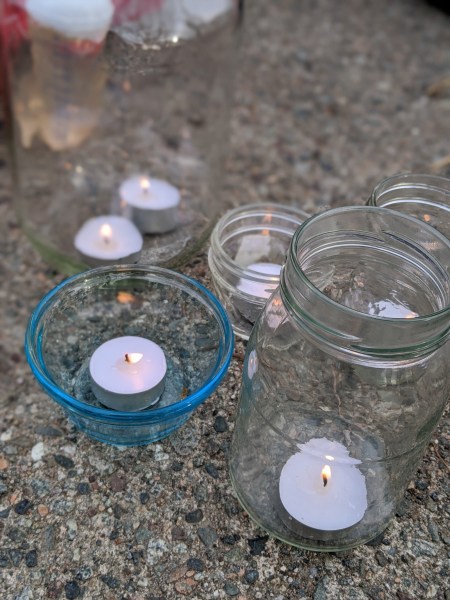
Gathered at the end of our driveway last night, we lit candles and sat on the ground. I told my son, 22 people died in Nova Scotia last week, and the people in Nova Scotia want us to be sad with them tonight.

What were their names? he wanted to know.

Tom, my mom said.

Heidi, I said, but that was all, because I couldn’t remember the others.

There is a concrete slab in our back yard where, two years ago, just after it had been poured, we wrote our kids’ names with sticks. Likely thinking of that, he asked if we could pour new concrete and write the names of the people who died so that we can remember and not forget.

Introductory remarks for Taapoategl & Pallet – January 8, 2020, Saint John Free Public Library (Market Square)

I am pleased to be here as a friend and admirer of Peter Clair and as a member of the board of commissioners at the Saint John Free Public Library. It is my great honor to welcome Peter and his beautiful family to this place. Saint John is, we know, a traditional meeting place, a place where nations have been gathering together for thousands of years, seeking effective ways of living alongside one another. So as we come together this evening, I am grateful for this opportunity to help recognize and honor the legacy of this land.

There are many reasons why I admire Peter’s novel, Taapoategl & Pallet, but tonight I want to talk very briefly about how this novel helps us honor the legacy of this land as a meeting place — a place of many nations — and how it allows us to practice living together and listening to one other. Listening isn’t always easy. In particular, Settler Canadians like me aren’t always very good at listening to Indigenous people. We don’t always know how to listen. We like to think that we are smart enough to understand most of everything that we encounter in our lives when in fact we don’t always have the contexts that we need to hear or understand.

This novel is about the land of the Mi’kmaq. We Settlers believe we know something true about that land — because that land is Nova Scotia and Prince Edward Island and a large part of New Brunswick and Gaspésie. These places are familiar to us as Settlers — maybe we’ve spent our whole lives in these places. Maybe our relationships with these places go back generations. But these places are stories, and we live so deeply inside of our own stories that it’s sometimes difficult for us to hear or understand stories about this place that are different or even contrary to the ones we already know.

And so this novel is about the land of the Mi’kmaq — land that is inhabited by figures from Mi’kmaw oral tradition. Like Malsem, Glooscap’s evil twin brother. Or Gionig, a trickster figure who randomly drowns and is then brought back to life by a smoke enema — which is something that you can actually find described in colonial recipe books as a possible cure for drowning. Or the Miiigemooesso, the generally benevolent forest spirits that become dangerous when they feel disrespected. These and other figures are alive in this novel and across the land of the Mi’kmaq. They are out there now in what you or I might call New Brunswick or Nova Scotia or Prince Edward Island, doing their thing, whether Settlers know or care or not. They are out there on the land, acting and living and waiting to share their stories with any visitors who are willing and able to listen.

And this is a novel about the people who were made by their homeland. People whose bellybuttons are buried all across their land, reminding them of their maternal connections to their home. People whose language captured the sounds of the land while it was becoming — the sounds of glaciers shifting, rivers turning into gulfs, and island separating from mainlands. People who were performing their stories and plays long before Marc Lescarbot’s Theatre of Neptune washed ashore in 1606. People who modeled an entire writing system after the marks that sucker fish make on the river banks — because humans are not the only beings who can write.

This is a novel about a whole world that Settlers in this region live inside but can’t see and don’t know. And it’s about the Mi’kmaq people — how they have survived us. Our brutal efforts to forget them and to make them forget themselves.

And I am so grateful for this gift — this story that we can read and re-read as we learn to see outside of our own stories and look at this place through the eyes of the people who were made here. Please join me in welcoming Peter Clair to this meeting place.

Introductory remarks for Distorted Descent – November 21, 2019, University of New Brunswick (Saint John Campus)

These remarks were delivered before a reading co-sponsored by the Office of the Piluwitahasuwin, the UNBSJ Faculty of Arts, the Lorenzo Society, and the Departments of Humanities and Languages/History and Politics. This event featured a respondent’s panel with Amanda Reid, Elder Miigam’agan, and Emma Hassencahl-Perley.

I’m pleased to welcome Dr. Darryl Leroux to campus and to Saint John. Saint John, or Menahkwesk, is, we know, a traditional meeting place. There were so many nations gathered here in Menahkwesk when Samuel de Champlain arrived in 1604 that he couldn’t tell whose territory this was. I am deeply grateful for this opportunity to honor the legacy of this land as a place where many nations have been gathering for thousands of years, seeking effective ways of being together and sharing space.

Dr. Leroux is a professor in the department of Social Justice and Community Studies at Saint Mary’s University in Halifax. His book, Distorted Descent: White Claims to Indigenous Identity, was published by the University of Manitoba Press in September of this year. It deals with a troubling social phenomenon in which white Settler Canadian people in places like Quebec and Atlantic Canada are systematically shifting into Indigenous identities and organizing themselves in ways that, he shows, actually oppose the rights and interests of Indigenous people and nations.

Dr Leroux’s work on this subject has been controversial. As you can imagine, he is considered a threat and an enemy by those whose claims to Indigenous identity he challenges in his scholarship. He is the only academic I know who has required security personnel at some of his lectures. I have feared for his safety! Thankfully, that is not the case here today, but undeniably, Dr Leroux’s work has been a major catalyst for a sensitive conversation that many people simply don’t want to have.

This book has also found a lot of support among Indigenous academics and communities, which is something that Amanda Reid, Elder Miigam’agan, and Emma Hassencahl-Perley will speak to shortly. The Mi’kmaw legal scholar Pam Palmater, Chair in Indigenous Governance at Ryerson University, says, “Distorted Descent is a brave, original piece of scholarship, offered in the context of a politically sensitive and socially controversial subject of Indigenous identity. His research exposes the extent to which white settler colonialism undermines Indigenous rights through the theft of Indigenous identity. It’s a real wake-up call.” Brenda MacDougall, Chair in Métis Research at the University of Ottawa, says, “This is a timely and important study highlighting Canada’s historical literacy about who Indigenous people really are which, coupled with an exponential growth in interest in genealogical research and DNA tests that trace your ancestry, has supported the claims of white-Canadians to Indigenous ancestry.”

And so we are pleased to welcome Darryl today to this meeting place, this place where we are still very much in the process of finding more empathetic, meaningful, and intentional ways of sharing space. Settler Canadians are not always good at sharing, and we do not always make the time for difficult, challenging, or uncomfortable conversations – conversations that might actually change our behaviours or help us do a better job of honoring historical agreements. And so we are grateful for work that helps us better honor and protect the legacy of meeting on this land with respect and care for one another. Please join me in welcoming Darryl Leroux to campus.

Family Separations, John Smith’s General Historie, and our Empathy Crisis

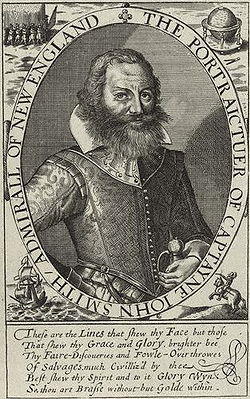
Halfway through John Smith’s General Historie of Virginia, New-England, and the Summer Isles (1624), the Powhatans and the English colonists exchange children. By this point in Smith’s text, the English have been customarily adopted into the Powhatan nation, a sophisticated polity that, before the arrival of the Virginia Company, consisted of more than thirty distinct peoples.

Smith describes the exchange as follows:

The next day [Christopher] Newport came a shore and received as much content as [the Powhatans] could give him: a boy named Thomas Salvage was then given unto [Wahunsenaca], whom Newport called his sonne; for whom [Wahunsenaca] gave him Namontack his trustie servant, and one of a shrewd, subtill capacatie. (p. 107)

In a forthcoming special issue of AlterNative: An International Journal of Indigenous Peoples — one dedicated to adoption and Indigenous citizenship orders, edited by Damien Lee and Kahente Horn-Miller — I discuss this moment in the context of Powhatan kinship and adoption protocols. This is just one of many scenes from Smith’s text that captures Wahunsenaca and the Powhatans in the process of solidifying social bonds that subsequent generations of colonists and Settlers should have had a difficult time breaking, had they at all understood or respected what was happening around them.

Time and again in Smith’s text, the English colonists struggle to glean or take seriously the implications of the Powhatans’ actions. Always teetering on the brink of starvation, the colonists remain frustratingly and, at times, absurdly oblivious to the able willingness of the Powhatans to demonstrate how to live happily and healthfully in Tsenacomoca.

Largely, my article is about the specific narrative process through which Smith disparaged, destroyed, and moved to supplant Powhatan kinship structures and obligations, consolidating patriarchal governance structures against existing Indigenous laws. When discussing the above mentioned scene in which the two sides trade children, I use sources from Mattaponi oral history, along with this excellent thesis on Indigenous customary adoption practices, to argue that through the exchange, the English entered into a common Powhatan familial arrangement — one that was generally reserved for close relatives, and one in which the needs of children and adults were weighted pretty much equally. From the perspective of the Powhatans, “a period of time living with another family member” would have been “a regular part of the upbringing and education of a child” (Trerise, p. 172). Such exchanges maintained and strengthened kinship relations within and across the diverse Powhatan polity, valuing and empowering children as useful and important diplomatic agents, building intimacy across distance and difference, and providing valuable opportunities for each community to learn more about the other through peaceful (or non-threatening) intermediaries.

Because I couldn’t discuss every aspect of this scene in my article, which, again, focuses primarily on Smith’s descriptions of Powhatan customary adoption practices, I wanted to explore another angle here — specifically, the idea that Smith, Newport, and the other English colonists would have been familiar with their own practice of exchanging children, and that their culturally specific practice might have been a significant part of what prevented them from understanding or empathizing with the Powhatans.

Briefly, in early modern England, family units were structured to uphold the power and authority of the state. Patriarchy infused and policed dominant social views, acting as what Stephanie Coontz calls, in her History of American Families, “the glue that bound individuals to households and households to communities” (p. 79). The primary function of colonial households was to mold children into subservient adults who would likewise reproduce the authority of patriarchal governance. In these structures, fathers — like political leaders — essentially had no hard and fast obligations to the people they ruled over. They were simply the authorities, and their households were the rigidly stratified, highly regulated environments that could train children to live obediently within the established hierarchies of English society.

This is why English families would commonly exchange children — not to forge or to deepen kinship relations or to empower children as important members of society but to actively circumvent parents’ natural instincts or impulses to respect or care tenderly for their own kids. Parents immersed in this political culture found it much easier to raise, train, and indeed abuse children who were not their own — children who they themselves did not love. Thus, for the good of the state and its structures, English children would be routinely separated from their families and sent to live among strangers. These separations would in turn help perpetuate the continuous and systematic reproduction of a society that, as a whole, lacked certain essential qualities — such as empathy.

[Here’s just one article about how childhood trauma and/or abuse affects empathy.]

Anglo-American colonial literature is in many ways the story of one society’s collective failure to extend empathy to another. But this legacy of childhood trauma also manifests today in the structures and functions of settler state bodies. In the context of contemporary U.S. political theory, the patriarchal family unit is in many ways similar to what George Lakoff describes as the “strict father” family model, which he locates at the “center of the conservative worldview.” In Moral Politics, he writes,

This model posits a traditional nuclear family, with the father having primary responsibility for supporting and protecting the family as well as the authority to set overall policy, to set strict rules for the behavior of children, and to enforce the rules. The mother has the day-to-day responsibility for the care of the house, raising the children, and upholding the father’s authority. Children must respect and obey their parents; by doing so they build character, that is, self-discipline and self-reliance. Love and nurturance are, of course, a vital part of family life but can never outweigh parental authority, which is itself an expression of love and nurturance—tough love. Self-discipline, self-reliance, and respect for legitimate authority are the crucial things that children must learn.

Once children are mature, they are on their own and must depend on their acquired self-discipline to survive. Their self-reliance gives them authority over their own destinies, and parents are not to meddle in their lives.

According to Lakoff, this model is where contemporary conservative morals come from, and it informs the way in which today’s conservatives view government. But Anglo-American Settlers of all political stripes have been using and abusing children to uphold, reproduce, and demonstrate the authority of this governance model since before Jamestown, and one of the most chilling ways in which we have always done this work is through the removal of children from their parents.

These separations help carry our empathy crisis into forever. And so we respond to refugees by closing our borders or by ripping babies from their families. We find new and creative ways of illegitimately removing Indigenous children from their communities and kin. And we live quietly under laws like the U.S. Family and Medical Leave Act, which guarantees only up to twelve weeks of unpaid leave to new parents, systematically frustrating breastfeeding efforts and/or confounding the production of oxytocin, the hormone responsible for the regulation of “social memory and cognition, emotion recognition, empathy, and attachment.”

Settlers urgently need to step back from their lives and think about the kind of world they want to live in. We do not understand what we are doing to others and to ourselves and why, what our governments are doing and why, or how much violence and suffering stems from our refusal to face or heal from our own suppressed histories.

Could a better understanding of those histories help us finally stop treating others so shamefully? I don’t necessarily know the answer to this, but it’s what I want to try.


Features from The Miramichi Reader

Several weeks ago I had the pleasure of electronically “meeting” James Fisher, The Miramichi Reader himself, after he wrote a generous review of my book, The Homing Place.

After I thanked him for his review, he asked if we could arrange an interview to chat more about where I’m coming from and what I’m working on, and I was grateful for the opportunity. Here is a link to that interview in its entirety.

Thank you again, Jim, for your thoughtful questions and your kindness!

News & gratitude

Last month, Lara Minja of Lime Designs was honoured for the absolutely stunning work she did on my book, The Homing Place, which will be showcased during the 2018 Association of University Presses Book, Jacket, and Journal Show in recognition of Lara’s beautiful typographic design. Lara is a graduate of the Nova Scotia College of Art and Design, and I am so grateful for the work that she did with this project!

28071054_10156186852939166_5048415626030780544_o

Even more recently, the book was selected as a finalist for two regional awards: the Writers’ Federation of New Brunswick Book Award for Non-Fiction and an Atlantic Book Award for Scholarly Writing. I was extremely surprised by these announcements, and more than anything else, perhaps, I am looking forward to the opportunity to meet and chat with other shortlisted authors at events in May and June. I don’t get out much these days. Peter J. Clair’s incredible book Taapoategl & Pallet, the best new novel I’ve read in some time, is a finalist for a New Brunswick Book Award in the fiction category, and there’s a question about periwinkles I’ve been dying to ask him.

My experience working with the team at Wilfrid Laurier University Press continues to be fantastic, and I’m grateful to Clare Hitchens for submitting my book for consideration in these competitions!

I’ll be reading from The Homing Place at the Central Branch of the Saint John Free Public Library on Tuesday, May 8 at noon as part of the Atlantic Book Awards Festival (the event  will be co-presented by Fog Lit Festival).

Maritime Urban Planning and the Interruption of Indigenous Life Ways

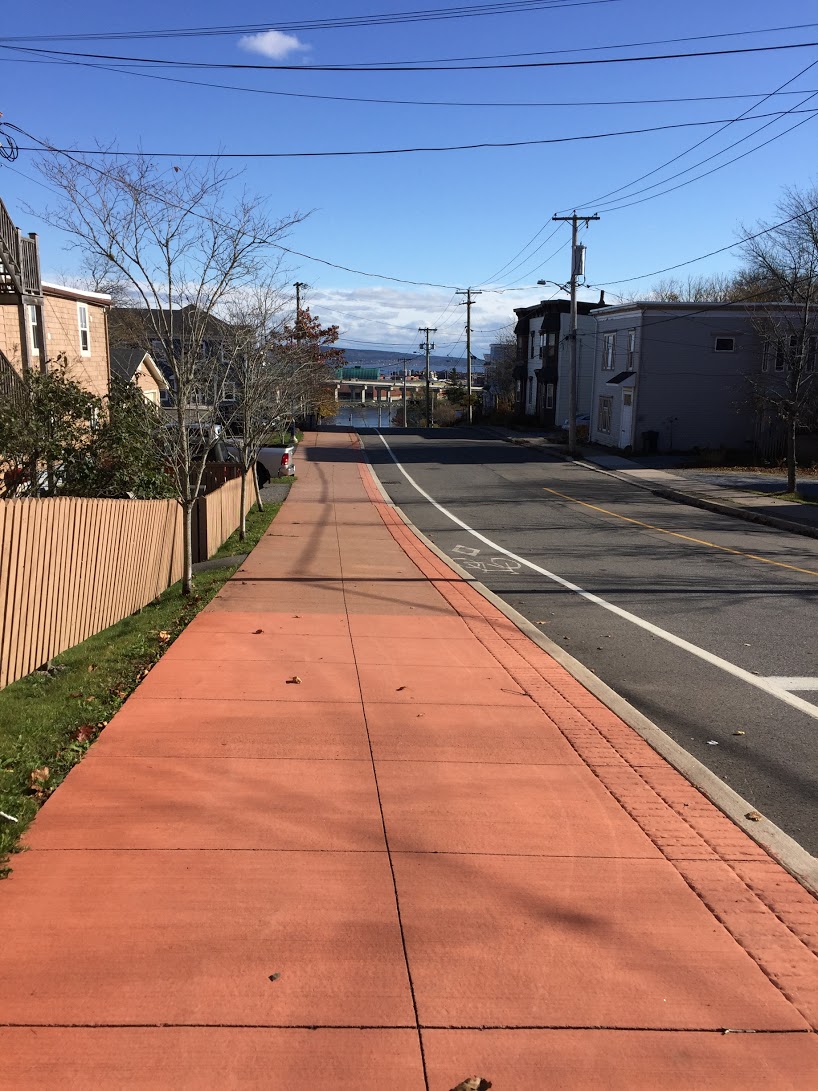
While out on a walk through Menahkwesk (Saint John, New Brunswick) yesterday, I took this picture from the top of what settlers call Bentley Street. This street was built over top of a Wolastoqiyik portage path, a key part of an extensive and ingenious transportation network that regional Indigenous people used for trade and travel. This is the view from the top of Bentley Street, facing the Saint John harbour:

IMG_3949

Before this road existed, Wolastoqiyik would travel this route on foot so they could reach the ocean from the river while strategically avoiding the treacherous rapids at what settlers usually call Reversing Falls — the mouth of the Wolastoq where the most powerful ocean tides in the world dramatically reverse the current of the river twice a day.

Based on recovered artifacts, archaeologists have very roughly estimated that for over 10,000 years, Indigenous people carried their canoes, babies, and cargo up and down this hill. After the Europeans arrived, Wabanaki peoples frequently used this route to bring furs and trade goods to the settlers at Fort LaTour.

From the same spot on Bentley Street, I turned around and took this picture of the New Brunswick Museum Archives. This building is directly between the Bentley portage route and the river. I’ve been inside this building many times — the cover image of my book is actually an iPhone photo of a text that is currently held in their collections. I am comfortable and happy in this building.

IMG_3947.jpg

On the other side of this massive building are the riverbanks where Wolastoqiyik would camp. This is now a protected archaeological area that the NB government hasn’t figured out what to do with yet.

Every time I walk here, I think about the fact that New Brunswick built this archive, dropped this massive rock, in the middle of this portage route. There is a metaphor here about the ways in which the settler colonial archive interrupts the life ways of the Wolastoqiyik — and about how we have built our archives over existing archives. Literally, in this case, we built an archive over more than 10,000 years worth of stories and memories and materials that developed continuously on and with this soil across millennia.

In Support of Wolustukyik Mothers and Grandmothers

IMG_3528

About thirty minutes north of Stanley, near Napadogan, New Brunswick, a group of Wolustukyik land and water defenders are building a culture and language camp. I was grateful for the invitation and opportunity to visit them a few weeks ago with my family, and they’ve not only built an impressive foundation for a lodge, but they’ve also successfully bartered for additional construction materials.

It’s cold and getting colder, and until they can get their winter shelter up, these women are living full time in a collection of tents and camping trailers. It’s very cozy in the trailers, but they have a continuous need for fuel (firewood + gas and propane for their generators), not to mention other essential supplies. Other ongoing construction projects include the installation of plumbing services.

As Settlers who live and make our family’s living in this territory, my partner and I have been doing what we can to support the mothers and grandmothers and their camp. As the Wolustukyik have always done, these women are showing us how to live in balance in this territory, how to be good neighbours, how to live in concert (rather than in power) with the other-than-human beings of the land, and how to take care of one another in the long term. As Settlers, we need to show that we’re listening and that we are doing our best to understand and learn. So it was an honour and a privilege to cozy into one of these trailers, to sit with these women for a few hours, to talk about measurable ways in which we could lend our skills and show our support, to chat and to listen to their stories. My son watched a Toy Story DVD while my daughter crawled around happily with a runny nose, and when we left, we did so with a new jar of bear grease that quickly soothed the raw skin on her upper lip.

I left behind two copies of my book, and one of those copies is currently up for grabs, along with many beautiful items, in a basket raffle. Here’s an image of just some of the items included in the basket:

22730214_1829560130687650_6419780401127941657_n

Most of these items were made by the mothers and grandmothers, and every dollar raised will support the construction of the camp. Tickets are $20 CAD and can be easily purchased through Andrea Polchies on Facebook.