Knowing to rest

This time last year I was descending rapidly into burnout. I hadn’t fully grasped just how unsustainably I was operating, but I felt deeply terrible and didn’t know how to trust what might happen to my career or my family if I stopped pushing. Things that seemed like opportunities for rest – weekend trips or retreats, lunches and suppers out, visits, invitations to connect or discuss how things were going with friends or mentors – all felt like more work. Every day and every conversation felt like more and more work, and work infused everything.

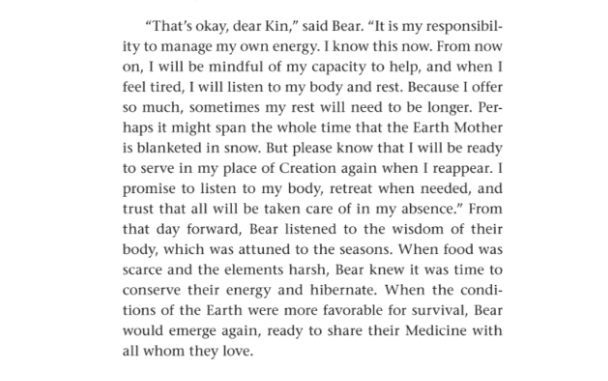
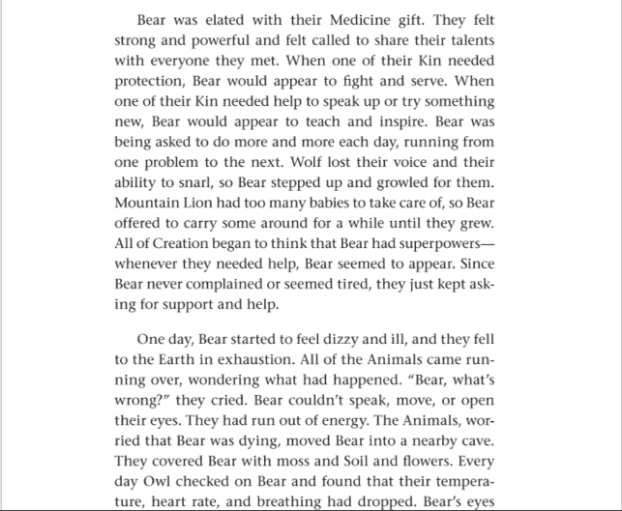
Ramona Nicholas had recommended a book to me, and I was listening to it on Audible during my commutes to Fredericton. What I’ve shared below is from the chapter “Mkwa Giizis: Bear Moon” in Asha Frost’s You Are the Medicine. This is a story about a talented, dependable bear who doesn’t know how to manage their own energy. When they burn out and get sick, they’re forced to rest for a season, but there is no choice in this rest. “It is my responsibility to manage my own energy,” Bear tells their friends and family after learning this hard lesson and emerging from their long season of recovery – “I know this now. From now on, I will be mindful of my capacity to help, and when I feel tired, I will listen to my body and rest.”

I really loved this story – I listened to it while sitting in my car outside of the office and texted Ramona afterward to say, thanks, I needed that. The story deeply resonated with me and I felt comforted, and so lately I have been thinking about what learning means for me. Where is my knowing? Because I heard, loved, and understood this story, thought it was beautiful, thought of it often, but it didn’t change the way I was operating at all. A few months later, I tweaked something in my back while out walking the dog in our neighbourhood. Didn’t listen to this either, just kept foolishly driving to Fredericton and meeting with students – I even went to a conference in Sackville. But I had to leave that conference a day early when I woke up one morning and couldn’t walk down the hallway. Gina Brooks pumped gas into my car that morning while I sat in the driver’s seat, unable to climb out myself, and then she followed me back to Menahkwesk in her truck to help me get from my car into the house. I ended up with a nerve injury that laid me up on the couch for a long season.

And so we learn the same hard way the bear does even when we hear the warning in their story and understand it in our bones. Even when we know what to do, we do something else instead — inexplicably and against our own knowing, against our own bodies. And we still don’t know if we’ve learned, really, and we worry all the time that maybe we are about to learn again.

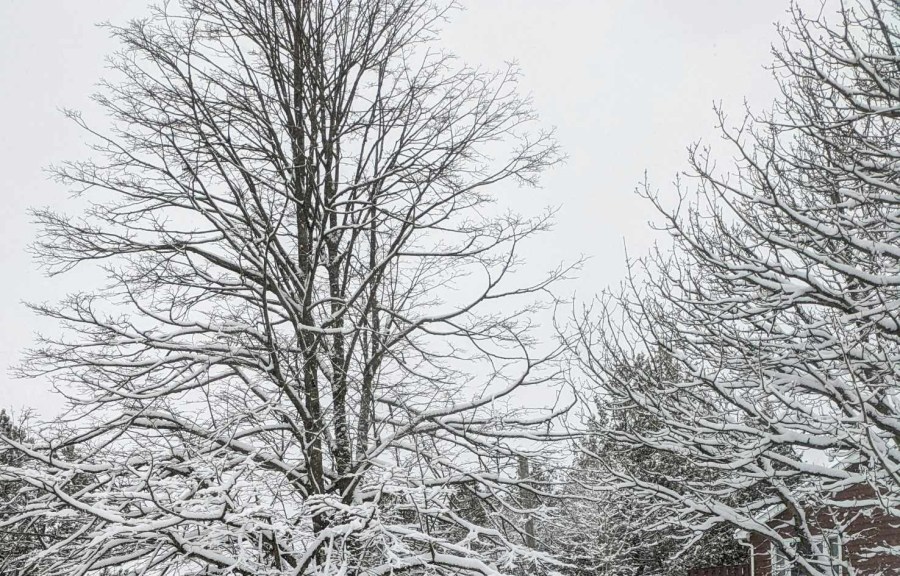
I share this story with you on the occasion of today’s big, beautiful snowfall in hopes that, if you are feeling that call to rest, the season won’t be too long.

Hiatus

Welcome, and thank you for your interest in my work. Please note that I am on leave from summer, 2018 until July, 2020. During this time, I will be slow responding to e-mails, but I will do my very best to get back to you. Thank you for understanding!

Yes, Canada Did Burn Down the White House in the War of 1812

Yesterday, the New York Times published a fairly smarmy piece by Daniel Victortitled “No, Mr. Trump, Canada Did not Burn Down the White House in the War of 1812.” Here is the crux of Victor’s argument:

“No, Canada did not burn down the White House during the War of 1812, which was fought with Britain over maritime rights. What is now Canada was not yet a country in 1812, but rather British colonies.

Canada didn’t become a nation until 1867, long after British troops did, in fact, burn down the White House in 1814. The fire gutted the president’s house along with several other crucial structures in Washington, which was still a relatively small town when the seat of government moved there 14 years earlier.

[…]

So you can’t really pin that on Canada, considering that Canada didn’t exist.”

Who is responsible for history? Reading Victor’s piece, I was reminded of another article that ran in the New York Times — this one by the Irish Member of Parliament William Trant, originally published in The Westminster Review in 1895. “Canada has never fought the Indians,” Trant argued in that piece,

“and she will not begin to do so now. Never has Canada had an Indian war; an Indian massacre is unknown in the annals of her history. She is too poor to seek glory by slaughtering the natives born of her soil, and too proud to defame her character or stain her escutcheon.”

In the first chapter of The Homing Place, I discuss how this kind of logic was developed to intentionally absolve Settler Canadians of everything that happened on Turtle Island prior to 1867. If the people who today call themselves “Canadians” spontaneously manifested with Confederation, then Settler Canada can’t be implicated in wars fought before that date — we remain pure and guiltless in everything from the Pequot War to Father Le Loutre’s War and beyond, even if the people who fought in those wars were our direct biological or cultural forebears.

As I’ve argued elsewhere, this kind of framing makes it very difficult for Settler Canadians to understand or historicize contemporary eruptions and ongoing conflicts, such as the clash at Elsipogtog in 2013. When we protect our societies against their histories, we make our present offences, systematic or otherwise, mostly unintelligible and even unpredictable to ourselves. And this makes us bad neighbours.

In Red Ink, Drew Lopenzina talks about how important the idea of continuance is for Indigenous writers and scholars seeking to help heal the cultural and historical ruptures that have been inflicted on their communities. Many Indigenous scholars are invested in the work of demonstrating continuity — demonstrating that their cultures and nations are the same cultures and nations that were here before colonization. Meanwhile, it seems that societies like mine have been involved in the reverse work — in establishing or maintaining our discontinuity with a past that we can’t bear to claim or associate with. 

We aren’t the only settler society who has changed its name and formation over the course of time, and I can’t help but wonder if Victor would extend this same disassociative logic to the United States, rendering history of the New England and Virginia colonies (for example) suddenly and exclusively British. Who owns the history of the Massachusetts Bay Puritans or the Salem witchcraft trials? What nations were produced by and through the New England colonial wars? Which chapter of my British history textbook contains the story of Benjamin Franklin’s kite experiment?

I understand that poking fun at Donald Trump’s endless gaffes can be a fun activity, even if it is a bit like shooting fish in a barrel. But given the historical mythology that pieces like Victor’s are helping to perpetuate this week, I wonder if we should’ve just left this one alone.